Showing posts with label embroidery. Show all posts

Monday, June 30, 2025

This month let's stand up to bullies, and sew ...

Feel free to print and enjoy!!

Americans, at our best, stand up to bullies and 
fight those who seek to demean and degrade others.

Cory Booker


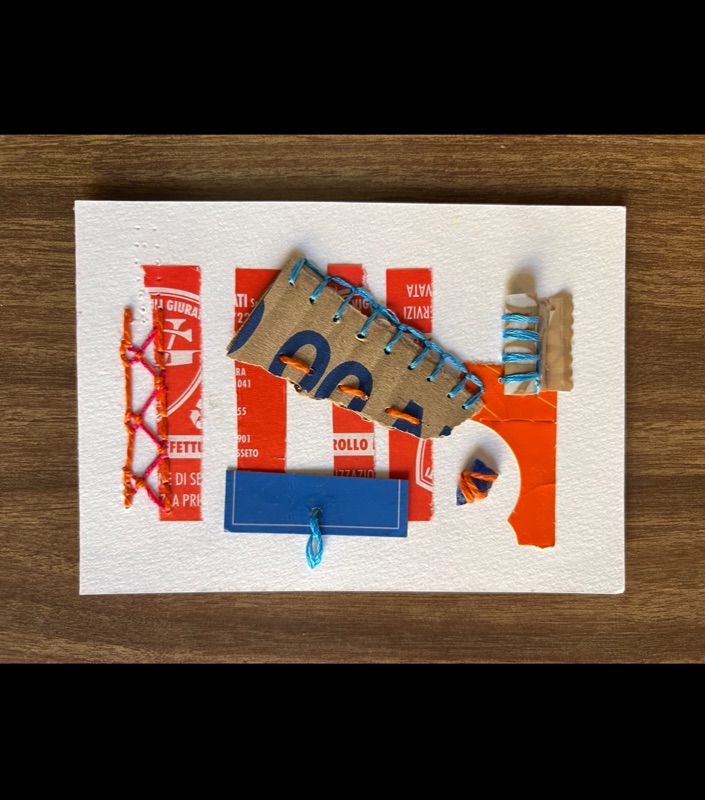
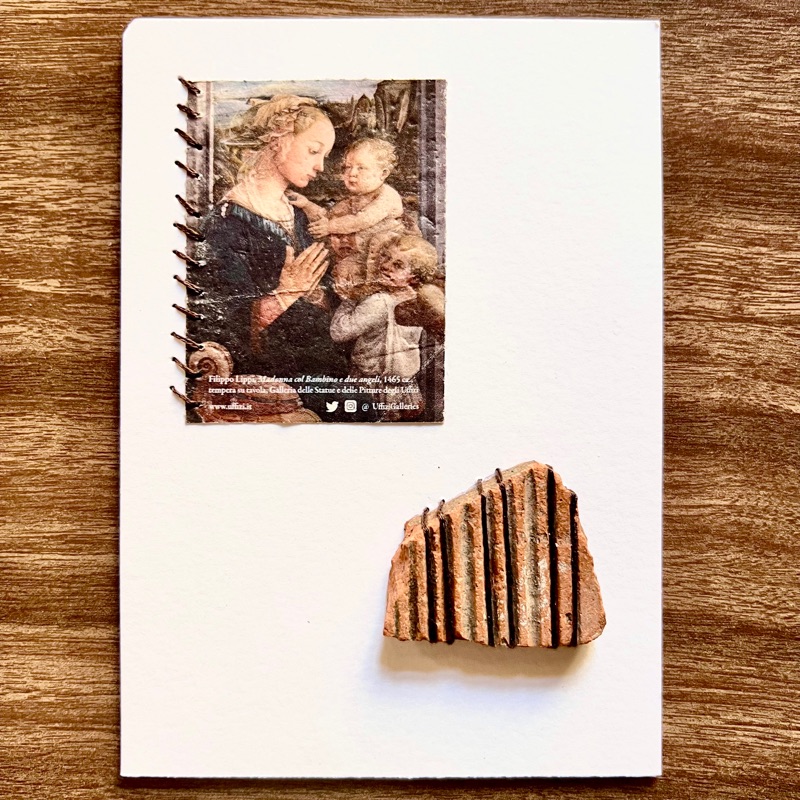
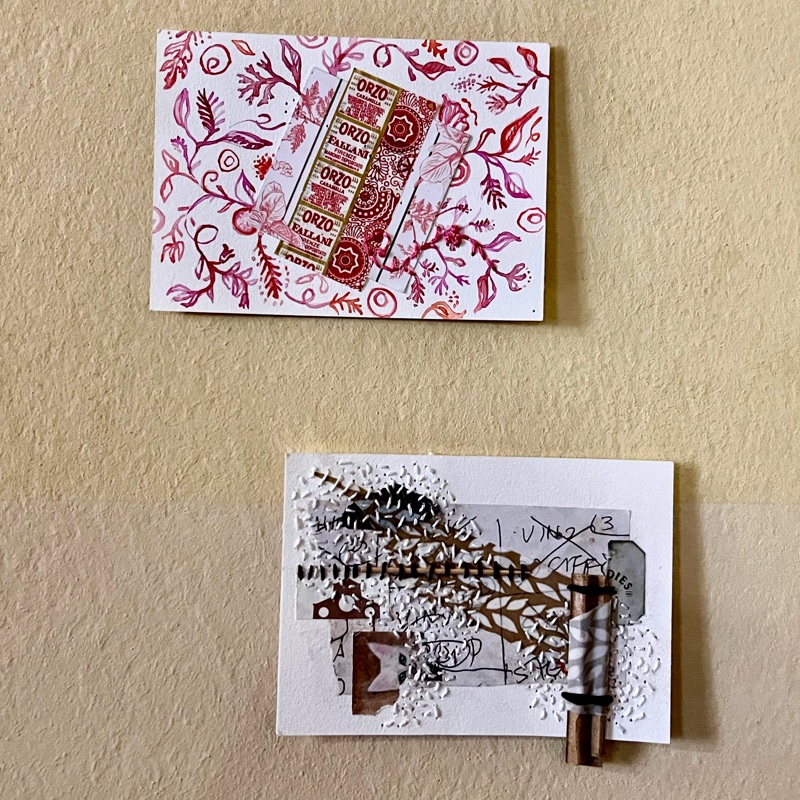
This month's #virginiacreates calendar reflects my renewed interest in embroidery.  During these unnerving times in our country I have felt a strong pull to my needles and thread.  I feel there are many reasons why I feel this need to stitch.  Sewing suggests mending, pulling pieces together that have been torn apart.  I feel that our country is being torn apart.

"The act of sewing is a process of emotional repair. - Louise Bourgeois"

Louise Bourgeois, used sewing in much of her work. She has eloquently explained what sewing meant to her and her work.  Many of her words speak to my current obsession with sewing so  I have sprinkled some of her quotes throughout this post.
“I always had the fear of being separated and abandoned. 
The sewing is my attempt to keep things together and make things whole.”— Louise Bourgeois
These past months I have found myself embroidering on both fabric and paper.  
I have been embroidering affirmations onto a vintage slip as part of my 'slip' series.  

When I was growing up all the women in my house used needles. I have always had a fascination with the magic power of the needle. The needle is used to repair the damage. — Louise Bourgeois

And in my current series, a protest to what I feel is censorship by the current administration, I am embroidering on vintage photos words that are being removed and discouraged by the government. 

The initial list that I am working from is from an article reposted by the New York Times, March 7, 2025.

These Words Are Disappearing

 in the New Trump Administration

There are around 196 words on that list.  Unfortunately as I do more researching there seems to be more removed words in different government agencies, so I am not sure how many photos I will be embroidering.  

Monday, May 26, 2025

bringing attention to the everyday to elevate it to the sacred ...

My roommate during my artist's retreat is very eloquent, as well as being a beautiful person inside and out. She described my work saying, “You gave a clear and compassionate vision for bringing attention to the everyday to elevate it to the sacred.”

That statement sums up my creative vision. Bringing attention to the everyday is a constant thread throughout my creative journey, from creating an international business selling jewelry and gift items made out of ‘used’ bottle caps to an 8 foot dress sculpture out of eggshells. 
Thank you Siobhan for such a succinct description of my creative process.

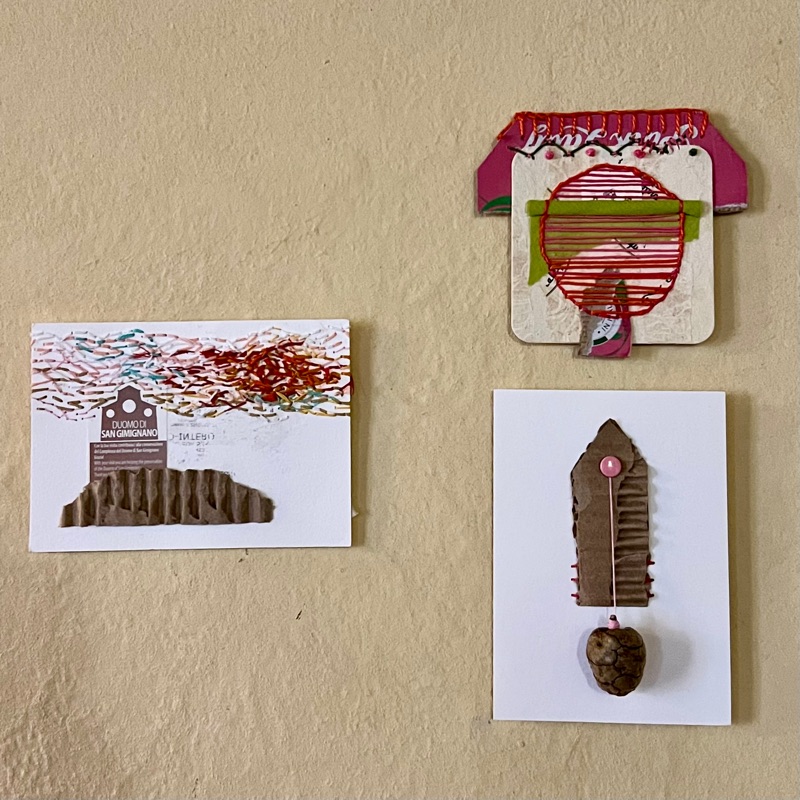
As I’ve mentioned earlier, in San Gimignano I started this series of site-specific mixed media collages. I created around 20 of these pieces, and was reluctant to stop.

Of course I had to bring back some of my found treasures. Needless to say, I was waiting for customs to question my need to bring ‘trash’ back with me. But that’s the point, it is not trash to me.  


Fortunately I wasn't searched or even questioned. So I have a few of my treasure with me, however I feel that an interesting element of this series is that it is site specific so I am applying to the Gallery 263's  2025 Artist in Residence to see what the streets of Cambridge might inspire! Wish me luck & peace.

Monday, April 9, 2018

a week full of art, poetry and midcentury treasures

    from the studio of virginia fitzgerald    
Share
Tweet
Forward
Share
Pin

MARK your CALENDARS ...

  • Tuesday, April 10th, 7-9pm. 
Opening Reception for 'A Long Distance Relationship' at the Attleboro Arts Museum, Attleboro Arts Museum,
86 Park St., Attleboro, MA 02703, 508.222.2644
This event will include a recognition ceremony that honors each exhibiting artist and exhibition partners. Free and open to all.
www.attleboroartsmuseum.org
  • Wednesday, April 11th:
CLOSING RECEPTION of "100 Extra Days"  6-8 PM
The Carney Gallery - Regis College
235 Wellesley Street, Weston, MA 02493

MORSE LIBRARY POETRY SLAM
Poetry SLAM! 7:00 PM - 9:00 PM @ TCAN

Slam is held at The Center for Arts,
14 Summer St., Natick, MA 01760
Experience the power of words in this multigenerational SLAM for beginners and seasoned performers where only the audience gets slammed.  Led by the dynamic Geof Hewitt at the historic  The Center for Arts in Natick the evening starts with participants of the Dr. Seuss group (those ages up to 15), then moves onto the Dickinson performers, ages 15 and up.  Prizes awarded to the top performer in each group
 Free to the general public
www.natickarts.org
  • Thursday, April 12th, 6- 8 PM.
1st RENEW Pop-up Trunk Show 
Contemporary Art, Mid-Century Antiques, Sustainable Fashion and Craft Brews together at Fountain Street!
@ Fountain Street Gallery
460C Harrison Avenue, Suite 2
Boston, Massachusetts 02118
www.fsfaboston.com
Taste Springdale by Jacks Abby‘s newest innovative barrel-aged ales and sour beers. www.springdalebeer.com

For more info. check out the links above or
send me an email:

va.fitzgerald (at) comcast.net

look forward to seeing you soon!
peace, Virginia

www.virginiafitzgerald.com
Copyright © 2018 Virginia Fitzgerald, All rights reserved.
Your are getting this email because you have shown an interest in the art of Virginia Fitzgerald, her 'dressproject ...' & her creative endeavors.

Our mailing address is:
Virginia Fitzgerald
25 Washington Ave.
the Winchell Building
Natick, Ma  01702

Add us to your address book


Want to change how you receive these emails?
You can update your preferences or unsubscribe from this list.

Email Marketing Powered by MailChimp

Saturday, March 11, 2017

Claire Wellesley-Smith


photo from claire wellesley-smith's blog
Today's feature is Claire Wellesley-Smith, a contemporary textile artist, living and working in  England.  I discovered Wellesley-Smith because I am reading her book,
Slow Stitch: 
photo from claire wellesley-smith's blog
a beautiful and inspiring book about slowing down and quality over quantity.  A concept I know I desire in our current, high-octane, 24/7, fast paced, always-connected life.  The idea of slowing down, turning off the electronics and tuning into the materials, the process and our surroundings seems like nirvana to me.  And in fact, this may be why I have returned to my embroidery practice, as a response to the current state of our country and the world.  I am aware of how my different 'work' cycles, either photography, sculpture, drawing, etc... and for the past few months I have been finding myself, nesting in the corner of my couch, with needle and embroidery floss and any scrap of fabric, paper, ribbon, 'life' that I can find and slowly sewing them together.  I call this body of work, 'meditations ...' 

So with my rekindled love of the stitch, I gravitated to Wellesley-Smith's book and then to her web site, blog and instagram account, all of which I have posted link to below.

fitzgerald, 'meditation #9 ...' (2017)


Besides her beautiful stitching, Wellesley-Smith talks about connecting textiles more to the earth and she discusses how she dyes her own textiles from plants that she grows in her studio garden.  (see video below).  She also features many other textile artists' work.  The book is a treasure to slowly cherish, I only wish I either had more hands so I could read and sew ... or more hours in the day!! But no matter I plan to savor this book and I recommend that you do too.
my contribution I made this January for a call for art by
GatherHere in Cambridge, MA
The Slow Stitching Movement is an illuminating revolution within the stitching and fiber art industry, launched by international quilting personality Mark Lipinski. Modeled after the international Slow Food movement, The Slow Stitching Movement is open to all fiber and needle artists and will prepare you for a higher form of creativity and important work in the needle and fiber arts, be it quilting, knitting, crochet, tatting, embroidery, rug hooking, weaving, needlepoint, cross stitch, etc.

Following the tenets of The Slow Stitching Movement you will:
Approach your creative art-making in a totally different way.
Recharge your passion for the needle fiber arts .
Engage the connection between your body, your quilts, and your legacy. .
Expand your creativity, self-esteem and even your spiritual journey.
Tap your right brain, to train and develop your imagination.
Find the creative genius in you.
Implement your creative thought in today’s too-fast world.
Heal your life, emotions and boost your physical health.
Create groups and habits to support your creative vision.

If you’ve hit a creative wall, if you have more yarn, fabric, floss, threads, and notions than you do inspiration, if all of your projects are beginning to look alike, or if you’ve been creating in the needle arts for years and have nothing especially wonderful to show for it . . . The Slow Stitching Movement is for you. 
 
THE SLOW STITCHING MOVEMENT  © 2013

Claire Wellesley-Smith's links:

website: www.clairewellesleysmith.co.uk


If the above video doesn't work, click herehttps://vimeo.com/123040597

Thursday, March 2, 2017

Naomi Shihab Nye

Today's feature is:


Since today is World Book Day, I thought it would be good to shine my spotlight on an author.  Also, this Sunday at church, I heard her poem, Gate A-4,  and knew I needed to share it.  It is such an inspiring piece and it speaks of the kind of world that I want to live in and which is being threatened by current affairs.  In fact I was so moved by Naomi Shihab Nye's words, that I came home and created this 'embroidered dress'. 
( I did say it is an inspiring piece)


Gate A-4
Naomi Shihab Nye, 1952


Wandering around the Albuquerque Airport Terminal, after learning
my flight had been delayed four hours, I heard an announcement:
“If anyone in the vicinity of Gate A-4 understands any Arabic, please
come to the gate immediately.”

Well—one pauses these days. Gate A-4 was my own gate. I went there.

An older woman in full traditional Palestinian embroidered dress, just
like my grandma wore, was crumpled to the floor, wailing. “Help,"
said the flight agent. “Talk to her. What is her problem? We
told her the flight was going to be late and she did this.”

I stooped to put my arm around the woman and spoke haltingly.
“Shu-dow-a, Shu-bid-uck Habibti? Stani schway, Min fadlick, Shu-bit-
se-wee?” The minute she heard any words she knew, however poorly
used, she stopped crying. She thought the flight had been cancelled
entirely. She needed to be in El Paso for major medical treatment the
next day. I said, “No, we’re fine, you’ll get there, just later, who is
picking you up? Let’s call him.”

We called her son, I spoke with him in English. I told him I would
stay with his mother till we got on the plane and ride next to
her. She talked to him. Then we called her other sons just
for the fun of it. Then we called my dad and he and she spoke for a while
in Arabic and found out of course they had ten shared friends. Then I
thought just for the heck of it why not call some Palestinian poets I know
and let them chat with her? This all took up two hours.

She was laughing a lot by then. Telling of her life, patting my knee,
answering questions. She had pulled a sack of homemade mamool
cookies—little powdered sugar crumbly mounds stuffed with dates and
nuts—from her bag—and was offering them to all the women at the gate.
To my amazement, not a single woman declined one. It was like a
sacrament. The traveler from Argentina, the mom from California, the
lovely woman from Laredo—we were all covered with the same powdered
sugar. And smiling. There is no better cookie.

And then the airline broke out free apple juice from huge coolers and two
little girls from our flight ran around serving it and they
were covered with powdered sugar, too. And I noticed my new best friend—
by now we were holding hands—had a potted plant poking out of her bag,
some medicinal thing, with green furry leaves. Such an old country tradi-
tion. Always carry a plant. Always stay rooted to somewhere.

And I looked around that gate of late and weary ones and I thought, This
is the world I want to live in. The shared world. Not a single person in that
gate—once the crying of confusion stopped—seemed apprehensive about
any other person. They took the cookies. I wanted to hug all those otherwomen, too.

This can still happen anywhere. Not everything is lost.


Naomi Shihab Nye, “Gate A-4” from Honeybee. Copyright © 2008 by Naomi Shihab Nye. 

Naomi Shihab Nye was born in St. Louis, Missouri in 1952. Her father was a Palestinian refugee and her mother an American of German and Swiss descent, and Nye spent her adolescence in both Jerusalem and San Antonio, Texas. Her experience of both cultural difference and different cultures has influenced much of her work. Known for poetry that lends a fresh perspective to ordinary events, people, and objects, Nye has said that, for her, “the primary source of poetry has always been local life, random characters met on the streets, our own ancestry sifting down to us through small essential daily tasks.” Characterizing Nye’s “prolific canon” in Contemporary Women Poets, Paul Christensen noted that Nye “is building a reputation…as the voice of childhood in America, the voice of the girl at the age of daring exploration.” In her work, according to Jane Tanner in the Dictionary of Literary Biography, “Nye observes the business of living and the continuity among all the world’s inhabitants…She is international in scope and internal in focus.” Nye is also considered one of the leading female poets of the American Southwest. A contributor to Contemporary Poets wrote that she “brings attention to the female as a humorous, wry creature with brisk, hard intelligence and a sense of personal freedom unheard of” in the history of pioneer women.

Nye received her BA from Trinity University in San Antonio, Texas and continues to live and work in the city. “My poems and stories often begin with the voices of our neighbors, mostly Mexican American, always inventive and surprising,” Nye wrote for Four Winds Press. “I never get tired of mixtures.” A contributor to Contemporary Southern Writerswrote that Nye’s poetry “is playfully and imaginatively instructive, borrows from Eastern and Middle Eastern and Native American religions, and resembles the meditative poetry of William Stafford, Wallace Stevens, and Gary Snyder.” Nye’s first two chapbooks were published in the 1970s. Both Tattooed Feet (1977)and Eye-to-Eye (1978) are written in free verse and structured around the theme of a journey or quest. They announced Nye as a “wandering poet”, interested in travel, place, and cultural exchange. In her first full-length collection, Different Ways to Pray (1980), Nye explores the differences between, and shared experiences of, cultures from California to Texas, from South America to Mexico. In “Grandfather’s Heaven,” a child declares: “Grandma liked me even though my daddy was a Moslem.” As Tanner observed, “with her acceptance of different ‘ways to pray’ is also Nye’s growing awareness that living in the world can sometimes be difficult.” 
Nye’s next books include On the Edge of the Sky (1981), a slim volume printed on handmade paper, and Hugging the Jukebox (1982), a full-length collection that also won the Voertman Poetry Prize. In Hugging the Jukebox, Nye continues to focus on the ordinary, on connections between diverse peoples, and on the perspectives of those in other lands. She writes: “We move forward, / confident we were born into a large family, / our brothers cover the earth.” Nye creates poetry from everyday scenes throughout Hugging the Jukebox in poems like “The Trashpickers of San Antonio” and the title poem, where a boy is enthusiastic about the jukebox he adopts and sings its songs in a way that “strings a hundred passionate sentences in a single line.” Reviewers generally praised Hugging the Jukebox, noting Nye’s warmth and celebratory tone. Writing in the Village Voice, Mary Logue commented that in Nye’s poems about daily life, “sometimes the fabric is thin and the mundaneness of the action shows through. But, in an alchemical process of purification, Nye often pulls gold from the ordinary.” According to Library Journal contributor David Kirby, the poet “seems to be in good, easy relation with the earth and its peoples.”

The poems in Yellow Glove (1986) present a more mature perspective tempered by tragedy and sorrow. In “Blood” Nye considers the Palestinian-Israeli conflict. She describes a café in combat-weary Beirut, bemoans “a world where no one saves anyone,” and observes “The Gardener” for whom “everything she planted gave up under the ground.” Georgia Review contributor Philip Booth declared that Nye brings “home to readers both how variously and how similarly all people live.” In Red Suitcase (1994), Nye continues to explore the effect of on-going violence on everyday life in the Middle East. Writing for Booklist, Pat Monaghan explained that “some of her most powerful poems deal with her native land’s continuing search for peace and the echoes of that search that resound in an individual life. Nye is a fluid poet, and her poems are also full of the urgency of spoken language. Her direct, unadorned vocabulary serves her well: ‘A boy filled a bottle with water. / He let it sit. / Three days later it held the power / of three days.’ Such directness has its own mystery, its own depth and power, which Nye exploits to great effect.”
Fuel (1998) is perhaps Nye’s most acclaimed volume. The poems range over a variety of subjects, settings and scenes. Reviewing the book for Ploughshares, Victoria Clausi regarded it as, above all, an attempt at connection: “Nye’s best poems often act as conduits between opposing or distant forces. Yet these are not didactic poems that lead to forced epiphanic moments. Rather, the carefully crafted connections offer bridges on which readers might find their own stable footing, enabling them to peek over the railings at the lush scenery.” Like her mentor, William Stafford, Nye again and again manifests her “belief in the value of the overlooked, the half-forgotten,” wrote Clausi, as well as investigating more “worldly concerns” like the Israeli-Palestinian conflict. Though Clausi believed that Nye’s “poetics require a calmer language,” a reviewer for Publisher’s Weekly found that “Nye’s witnessings of everday life and strife never quite acquire collective force, yet they convey a delicate sense of moral concern and a necessary sense of urgency.”
After the World Trade Center attacks in 2001, Nye became an active voice for Arab-Americans, speaking out against both terrorism and prejudice. The lack of understanding between Americans and Arabs led her to collect poems she had written which dealt with the Middle East and her experiences as an Arab-American into one volume. 19 Varieties of Gazelle: Poems of the Middle East (2002) received praise for the timeliness of its message. Publisher’s Weekly declared that it was “an excellent way to invite exploration and discussion of events far away and their impact here at home.” Nye’s next book, You and Yours (2005), continues to explore the Middle East and the possibilities of poetic response. Divided into two sections, the first deals with Nye’s personal experiences as a mother and traveler and intersperses Nye’s typical free-verse with prose poems. Part two examines the Middle East with “indignity and compassion,” according to Publisher’s Weekly. Donna Seaman wrote that the book is “tender yet forceful, funny and commonsensical, reflective and empathic,” adding, “Nye writes radiant poems of nature and piercing poems of war, always touching base with homey details and radiant portraits of family and neighbors. Nye’s clarion condemnation of prejudice and injustice reminds readers that most Americans have ties to other lands and that all concerns truly are universal.”
In addition to her poetry collections, Nye has produced fiction for children, poetry and song recordings, and poetry translations. She has also produced a book of essays, Never in a Hurry (1996), and edited several anthologies, including the award-winning This Same Sky (1992), which represents 129 poets from sixty-eight countries. In her introduction to the anthology Nye writes, “Whenever someone suggests ‘how much is lost in translation!’ I want to say, ‘Perhaps—but how much is gained!’“ Booklist critic Hazel Rochman called it “an extraordinary anthology, not only in its global range…but also in the quality of the selections and the immediacy of their appeal.” Nye also compiled and edited a bilingual anthology of Mexican poetry, The Tree Is Older Than You Are (1995).Nye edited the collection I Feel a Little Jumpy around You (1996), which combines 194 “his and her” poems, pairing a poem written by a man with one written by a woman. And Nye’s anthology The Space between Our Footsteps (1998) is a collection of the work of 127 contemporary Middle-Eastern poets and artists representing nineteen countries.
As a children’s writer, Nye is acclaimed for her sensitivity and cultural awareness. Her book Sitti’s Secrets (1994) concerns an Arab-American child’s relationship with her sitti—Arabic for grandmother—who lives in a Palestinian village. Hazel Rochman, in Booklist,praised Nye for capturing the emotions of the “child who longs for a distant grandparent” as well as for writing a narrative that deals personally with Arabs and Arab Americans. In 1997 Nye published Habibi, her first young-adult novel. Readers meet Liyana Abboud, an Arab-American teen who moves with her family to her Palestinian father’s native country during the 1970s, only to discover that the violence in Jerusalem has not yet abated. As Liyana notes, “in Jerusalem, so much old anger floated around…[that] the air felt stacked with weeping and raging and praying to God by all the different names.” Autobiographical in its focus, Habibi was praised by Karen Leggett, who noted in the New York Times Book Review that the novel magnifies through the lens of adolescence “the joys and anxieties of growing up” and that Nye is “meticulously sensitive to this rainbow of emotion.” Nye sees her writing for children as part of her larger goals as a writer. As Nye explained to a Children’s Literature Review contributor, “to counteract negative images conveyed by blazing headlines, writers must steadily transmit simple stories closer to heart and more common to everyday life. Then we will be doing our job.”

Nye told Contemporary Authors: “I have always loved the gaps, the spaces between things, as much as the things. I love staring, pondering, mulling, puttering. I love the times when someone or something is late—there’s that rich possibility of noticing more, in the meantime…Poetry calls us to pause. There is so much we overlook, while the abundance around us continues to shimmer, on its own.”

Wednesday, March 2, 2016

craftivism: is a form of activism that is centered on practices of craft/art

my contribution to @whatchidid's project  

Craftivism:  a form of activism, typically incorporating elements of anti-capitalism, environmentalism or third-wave feminism, that is centered on practices of craft - or what can traditionally be referred to as "domestic arts". Craftivism includes, but is not limited to, various forms of needlework. Craftivism is a social process of collective empowerment, action, expression and negotiation. In craftivism, engaging in the social, performative and critical discourse around the work is central to its production and dissemination. [1] Practitioners are known as craftivists. (definition from wikipedia.org)
I love the concept: craftivism, as it embodies two ideas that I feel passionate about: making my voice heard and making things.  So when I saw this project, "Draw the Line" by @Whatchidid I just HAD to participate ~ Embroidery and Women's rights.

photo: @whatchidid

photo: @whatchidid
Artist Chi Nguyen (@Whatchidid )—in partnership with the Textile Arts Center and the Center for Reproductive Rights—put a call out to anyone who wanted to participate:
The public is invited to Draw the Line by joining the embroidery process at the stitch-ins, or by sending in their own 10x10” swatches with as many tally marks (卌) as they would like to embroider. All swatches will be patched onto a larger quilt to be used at the Supreme Court rally on March 2nd, 2016. ** (she is continuing to add swatches after today so don't despair)
Many stitch-ins were hosted and swatches were sent from all over the world; as of yesterday @whatchidid stated that the quilt now represented 300,000 embroidered lines with submissions from 34 states and 6 countries and the project is still going.  Today the quilt stood outside the Supreme Court of the United States but @whatchidid is still collecting swatches, her aim is to have 

5.4 million lines to represent the 5.4 million women of reproductive age from accessing the healthcare they need. So if you are interested grab your needle and hoop.


I learned of the project while taking my daughter on a college tour via Amtrak, but luckily for me I always travel with a needle and embroidery hoop and floss (I always think I would do really well on the Monty Hall version of 'Let's make a Deal' (Monty) "Let's see what you have in your purse" , (me) "well I have a paint brush, glue stick, pliers, ... ) 


It has been really interesting to see the different swatches and different interpretations on these swatches while just using tally marks!! Below is more information, links to articles about the project and photos,  along with the link to Artist Chi Nguyen (@Whatchidid )'s web site where you can find all the information about how to participate.  


photo: @whatchidid


"On March 2nd, 2016, the United States Supreme Court will hear the most important reproductive rights case in almost 25 years. The decision will determine whether Texas can shut down nearly all abortion care providers in the state and prevent 5.4 million women of reproductive age from accessing the healthcare they need."


DrawtheLine.org where you can see pictures of many of the beautiful swatches.

“Because this is a very public and collaborative project,” Nguyen says, “some might want to embroider one line and others might want to embroider all 5.4 million. I think that’s the beauty of it. When we surpass the original number, we ourselves become ‘and Counting.'”

from the article about the project on VICE.com:


How will the quilt function at the rally? 
I really wanted to use a quilt because it represents comfort, safety, and security, and the lack of access to abortion care and reproductive health care in general is anything but that. The quilt represents those things for me and also creates a sense of unity from supporters across the US who can send in swatches, which we will sew together. Right now, I have no idea how many swatches we will get by March 2. If we don't get enough, we will hold stitch-ins at the rally, but if we finish, we will use it as a banner. However, it won't just be a banner. It will also provide warmth.


peace